
Ayutthaya is one of those places where you can step off a train in the morning and, a few minutes later, find yourself standing beside the ruins of a city that was once one of Southeast Asia’s great powers.
I remember my first proper day in Ayutthaya. I arrived earlier than I expected, bought a cold bottle of water from a small shop near the station, and immediately realized two things: the ancient city was much bigger than it looked on a map, and I had absolutely no business trying to walk everywhere in the Thai heat.
That second lesson came quickly.
Ayutthaya was the capital of the Kingdom of Ayutthaya for 417 years, and today’s historical park contains hundreds of archaeological sites spread across the old city. The central historical park is a UNESCO World Heritage site, with the Chao Phraya, Pa Sak and Lopburi rivers surrounding the old city area.
You can see the highlights in one day, but only if you don’t waste half the morning figuring out where to go.
Here are the six places I would prioritize.
Ayutthaya Day Trip at a Glance
| Sight | Suggested time | Entry fee | Best time |
|---|---|---|---|
| Wat Mahathat | 45–60 min | Around ฿50 | Early morning |
| Wat Ratchaburana | 30–45 min | Around ฿50 | Morning |
| Wat Phra Si Sanphet | 45–60 min | Around ฿50 | Morning |
| Viharn Phra Mongkhon Bophit | 20–30 min | Free | Morning |
| Wat Lokayasutharam | 15–20 min | Free | Morning/late afternoon |
| Wat Chaiwatthanaram | 45–60 min | Around ฿50 | Late afternoon |
Note: The Ayutthaya Historical Park itself is officially listed by Thailand’s Tourism Authority as open daily from 8:00 AM to 6:00 PM, with a ฿40 foreigner admission fee for the park. Individual major monuments can have separate admission arrangements, and current ticketing can change, so I keep some small notes and cash with me rather than assuming one ticket covers everything.
1. Wat Mahathat — The Buddha Head in the Tree
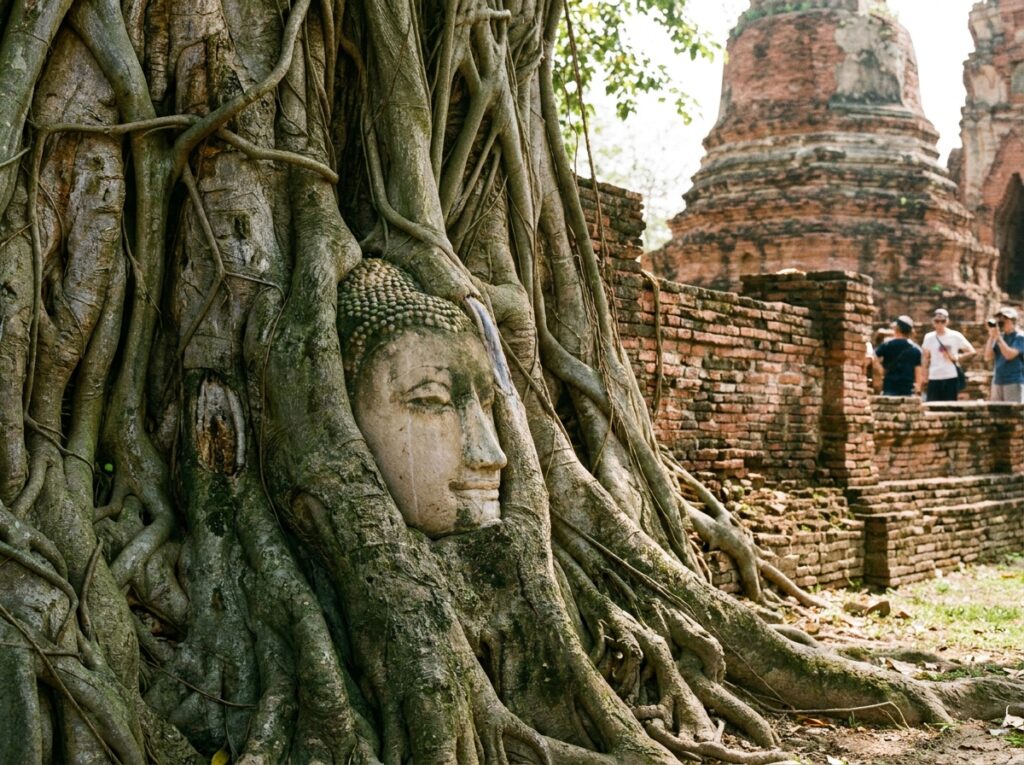
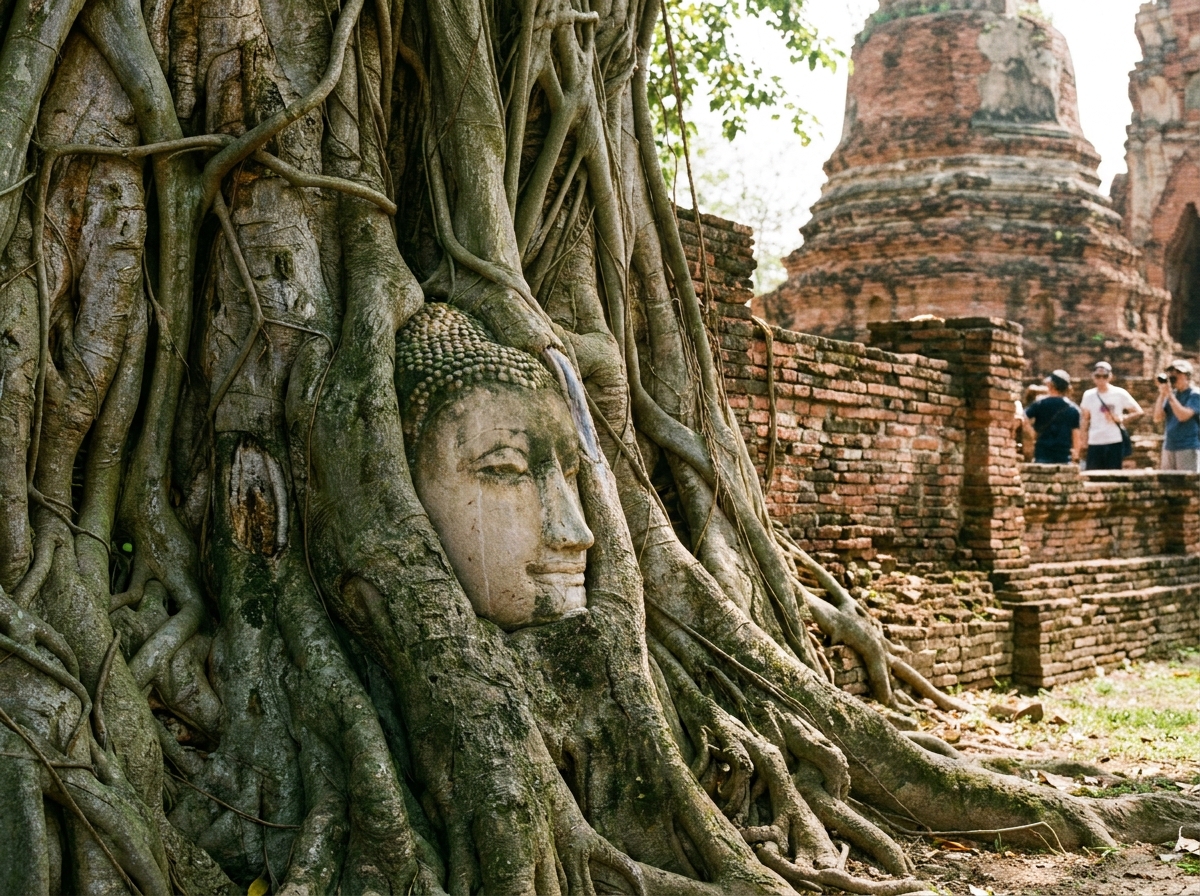
If you’ve seen one photograph of Ayutthaya before arriving, there’s a good chance it was this one.
The stone Buddha head surrounded by the roots of a tree at Wat Mahathat has become one of Thailand’s most recognizable archaeological images.
But the photograph doesn’t really explain the atmosphere.
Walk beyond the famous tree and you’ll see rows of damaged Buddha images, brick prangs and ruined structures spread around the temple grounds. This is where Ayutthaya starts making sense to me—not as a collection of Instagram locations, but as the remains of a huge former capital.
Thailand’s Tourism Authority lists Wat Mahathat as open daily from 7:30 AM to 6:00 PM.
What to see
- The Buddha head in the tree roots
- The central prang
- Rows of headless Buddha images
- Ancient brick walls
- Remains of the temple’s former structures
My tip
Arrive around 7:30–8:00 AM.
The difference between photographing the Buddha head early and trying to do it when a large tour group arrives is enormous.
There’s also an etiquette point worth remembering: don’t stand higher than the Buddha head or lean against the tree for a selfie.
It’s a religious image, not a theme-park prop.
2. Wat Ratchaburana — Go Inside the Prang
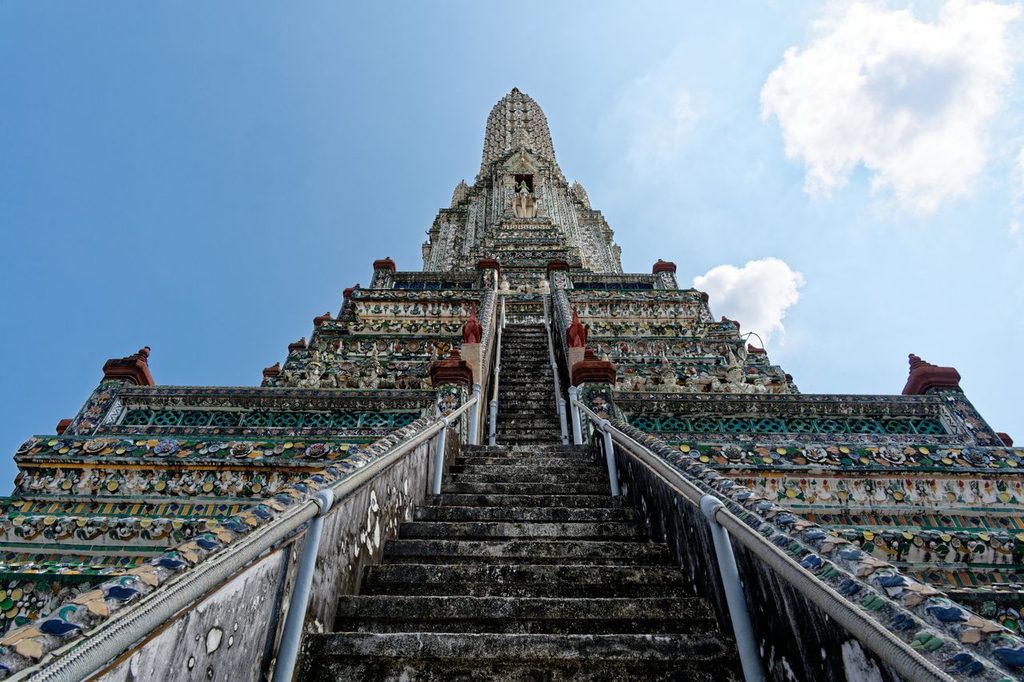
Wat Ratchaburana is just a short distance from Wat Mahathat, which makes these two an easy pair.
This temple was built in the early Ayutthaya period and is particularly interesting because you can see the influence of Khmer-style architecture in its central prang.
What I like here is that it feels more three-dimensional than simply looking at ruins from outside.
The large central tower dominates the site, while the surrounding remains give you a sense of the original scale.
If access is operating normally, the central prang and its interior areas are especially worth seeing.
Practical details
- Location: Near Wat Mahathat
- Suggested visit: 30–45 minutes
- Admission: Budget around ฿50
- Best time: Before the midday heat
- Transport: Walk from Wat Mahathat or take a bicycle/tuk-tuk
I usually don’t spend hours here.
Instead, I take my time around the main prang, look at the architectural details, then move on while the temperature is still manageable.
3. Wat Phra Si Sanphet — The Royal Temple
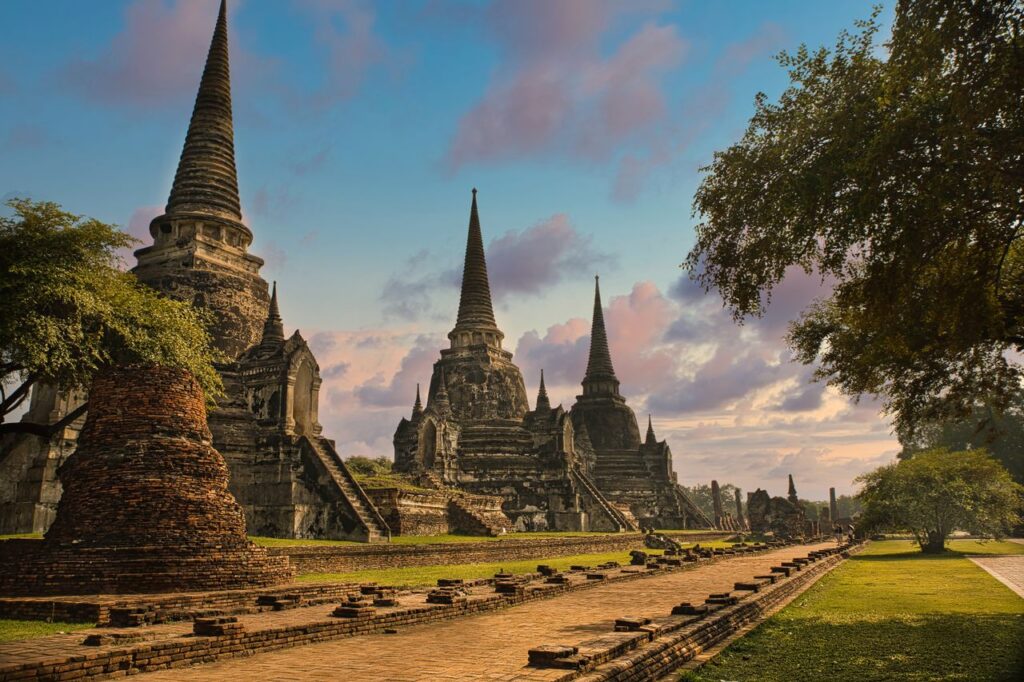
If Wat Mahathat gives you the atmospheric ruins, Wat Phra Si Sanphet gives you the royal scale.
This was the most important temple within the royal palace complex of Ayutthaya and is famous for its three large chedis.
They’re among the most recognizable structures in the old city.
Standing in front of them, I always find myself imagining what this area must have looked like before the destruction of Ayutthaya in the eighteenth century.
Today, the three chedis remain remarkably photogenic, especially when the sun is still relatively low.
Practical details
- Admission: Around ฿50 for foreign visitors
- Suggested time: 45–60 minutes
- Best time: 8:30–10:00 AM
- Dress: Shoulders and knees covered
- Nearby: Viharn Phra Mongkhon Bophit
Don’t make the mistake of visiting only the chedis, taking one photograph and leaving.
Walk around the perimeter.
The scale becomes much clearer when you’re standing among the remaining foundations and columns.
4. Viharn Phra Mongkhon Bophit — A Useful Break From the Ruins
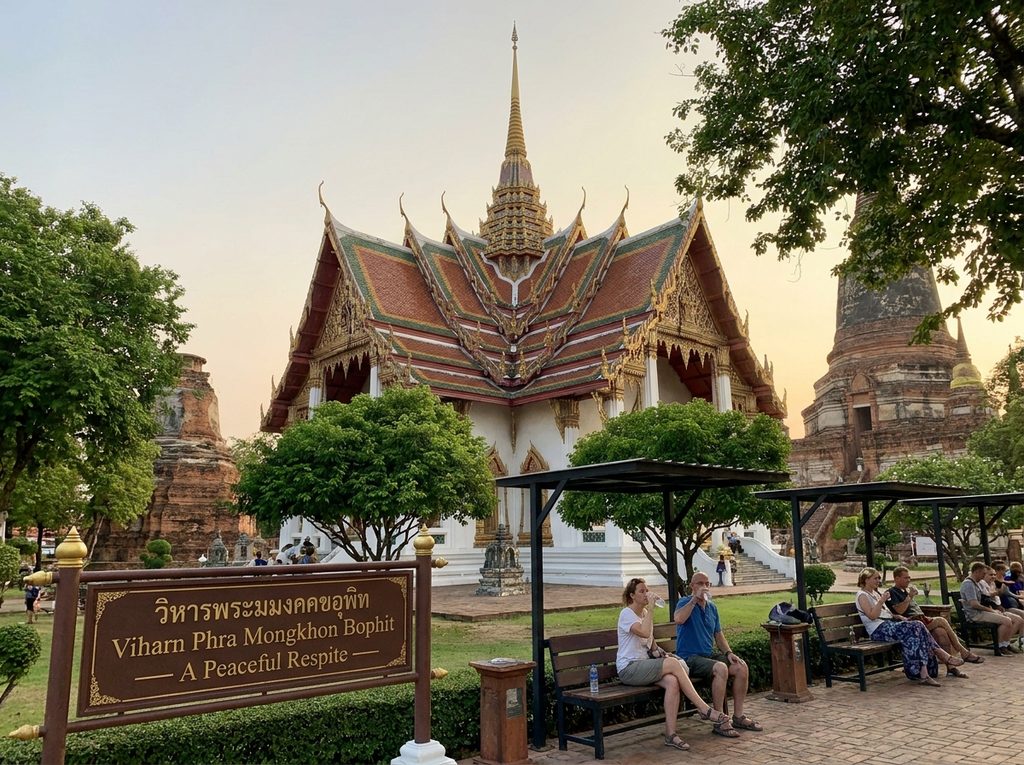
Right next to Wat Phra Si Sanphet is Viharn Phra Mongkhon Bophit, home to one of Thailand’s large Buddha images.
This stop is different from the archaeological ruins.
You enter a functioning religious building, and the atmosphere changes immediately. After walking around under the sun, stepping inside can feel like entering an air-conditioned room—even though it isn’t.
The interior is cooler and quieter, and the enormous Buddha image dominates the space.
Practical details
- Entry: Generally free
- Suggested visit: 20–30 minutes
- Location: Beside Wat Phra Si Sanphet
- Best time: Morning
- Dress: Respectful clothing required
This is also a good place to slow down.
Ayutthaya sightseeing can become surprisingly tiring. I like using this stop as a natural pause before continuing to the next ruins.
And remember to remove your shoes if signs or temple staff request it.
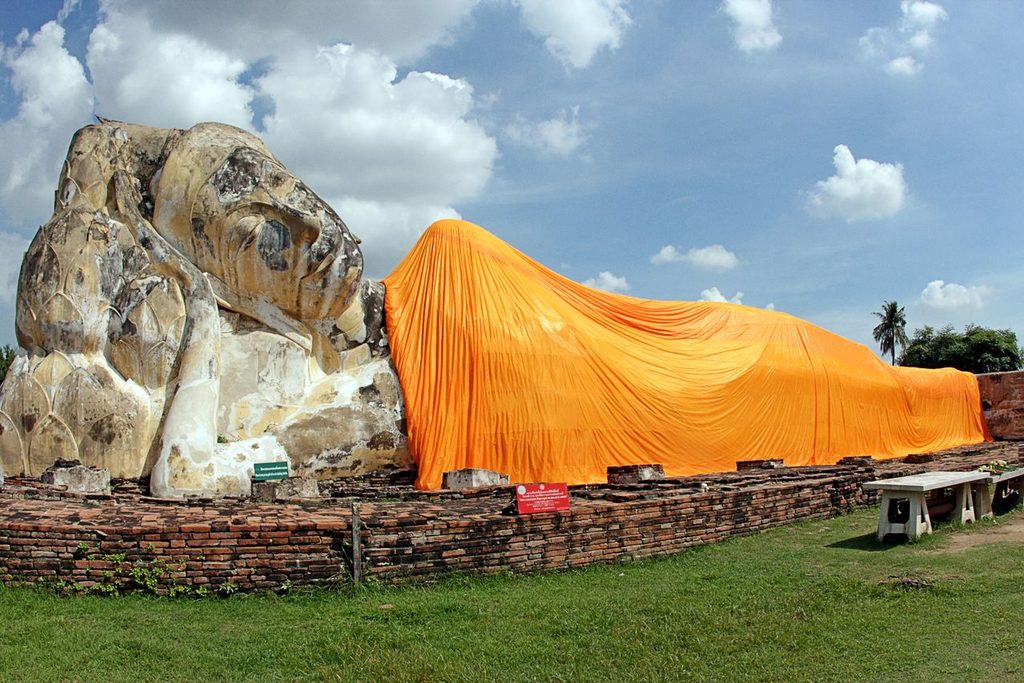
5. Wat Lokayasutharam — The Giant Reclining Buddha
6
The reclining Buddha at Wat Lokayasutharam is one of the easiest stops on a day trip because you don’t need to spend an hour exploring a huge temple complex.
The Buddha lies outdoors, with the surrounding ruins providing the backdrop.
I usually come here for a short stop, particularly when I’m already moving between the central temples and Wat Chaiwatthanaram.
Why it’s worth seeing
The scale of the reclining Buddha is impressive, but the setting is what makes the photograph.
There’s something slightly surreal about seeing such a large Buddha image lying peacefully among the remains of the old capital.
Practical details
- Entry: Free
- Suggested visit: 15–20 minutes
- Best time: Morning or late afternoon
- Transport: Easy by tuk-tuk, bicycle or private driver
- Nearby: Several smaller ruins
Don’t plan your entire day around this one.
See it, take a respectful photograph, look around the surrounding ruins and continue.
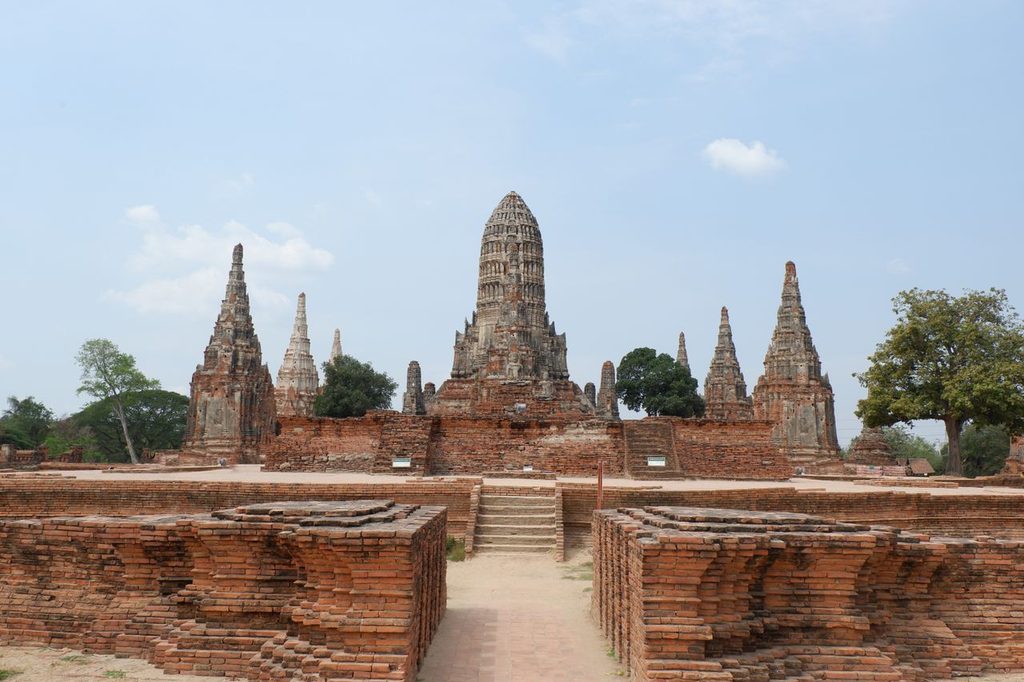
6. Wat Chaiwatthanaram — Save This One for Late Afternoon
6
This is the one I would save for the end of the day.
Wat Chaiwatthanaram sits beside the Chao Phraya River outside the main island, and its large central prang surrounded by smaller prangs creates one of Ayutthaya’s most dramatic views.
Thailand’s Tourism Authority describes it as one of the city’s particularly significant and beautiful ancient monuments. It was built during the reign of King Prasat Thong and reflects Khmer-influenced architectural forms.
Late afternoon is when it really works for me.
The harsh midday light starts disappearing, the brick changes color and the shadows become longer.
If you’re lucky with the weather, the final hour of sunlight can make the entire temple look warm and almost copper-colored.
Practical details
- Admission: Around ฿50
- Suggested time: 45–60 minutes
- Best time: Around 4:00–5:30 PM
- Location: West of the main island
- Transport: Tuk-tuk, bicycle, scooter or private car
There have also been seasonal evening illumination events at Ayutthaya’s major monuments. For example, Tourism Thailand reported a special program covering Wat Chaiwatthanaram and other sites from December 2025 through February 2026.
Those events are seasonal, though, so don’t assume the temple is normally open for general nighttime sightseeing.
How to Get From Bangkok to Ayutthaya
This is the easy part.
Ayutthaya is approximately 86 kilometers north of Bangkok, making it one of the most practical historical day trips from the capital.
By Train
This is my favorite option if I’m traveling solo.
You can travel from Bangkok’s railway network to Ayutthaya Station, then arrange local transport from there.
The journey is inexpensive compared with private transportation, although travel times and fares vary depending on the train service.
Once you arrive:
- Walk toward the ferry crossing
- Cross to Ayutthaya island
- Rent a bicycle, hire a tuk-tuk or arrange a car
Why I like the train
It feels more like a real Thailand travel day.
You can sit by the window, watch the city disappear and gradually see more open countryside.
Just don’t make the mistake of arriving at Ayutthaya at noon.
The heat will punish you.
By Private Car or Driver
If you’re traveling with two or more people, a private car can make sense.
The main advantage isn’t luxury.
It’s time.
Your driver can take you directly between:
Wat Mahathat → Wat Ratchaburana → Wat Phra Si Sanphet → Viharn Phra Mongkhon Bophit → Wat Lokayasutharam → Wat Chaiwatthanaram
You won’t have to keep negotiating with tuk-tuk drivers.
For a group, the extra cost can be worth it.
By Tour
Organized tours from Bangkok are the easiest option if you don’t want to plan anything.
The downside is that your schedule is no longer really yours.
You’ll usually have a fixed departure, fixed lunch stop and fixed amount of time at each temple.
I prefer independent travel because Ayutthaya rewards slowing down.
But if it’s your first time in Thailand and you’re uncomfortable navigating independently, a reputable small-group tour is perfectly reasonable.
Bicycle, Tuk-Tuk or Grab?
Once you’re in Ayutthaya, transportation becomes more important.
Bicycle
Great during cooler months.
Not my first choice in April.
I’ve tried cycling around ancient ruins in extreme heat, and by the third temple I was less interested in history and more interested in finding an ice-cold drink.
Tuk-Tuk
Probably the most practical option for a first-time visitor.
Agree on the total price and itinerary before starting.
Don’t simply ask, “How much?”
Instead say:
“Six temples, three hours. How much total?”
That avoids confusion later.
Grab
Useful, but availability can be less predictable than in central Bangkok.
For a full day of temple hopping, I’d rather arrange a driver or tuk-tuk in advance.
My Ideal One-Day Ayutthaya Itinerary
If I were doing this trip tomorrow, I’d follow this schedule.
7:00 AM
Leave Bangkok.
8:30 AM
Arrive in Ayutthaya.
8:45 AM
Wat Mahathat
Spend about 45 minutes.
9:40 AM
Wat Ratchaburana
Allow 30–45 minutes.
10:30 AM
Wat Phra Si Sanphet
Explore for about an hour.
11:30 AM
Viharn Phra Mongkhon Bophit
Take a short break.
12:00 PM
Lunch.
Try local Ayutthaya dishes such as:
- Boat noodles
- Grilled river prawns
- Roti sai mai
Ayutthaya is particularly known for river prawns and the famous cotton-candy-wrapped roti dessert. Tourism Thailand specifically highlights both as local food experiences.
1:30 PM
Wat Lokayasutharam
Quick visit.
2:00 PM
Coffee or rest.
This part is important.
Don’t underestimate the heat.
4:00 PM
Wat Chaiwatthanaram
Take your time.
5:15 PM
Head back toward Ayutthaya Station.
6:00 PM onward
Train back to Bangkok.
The exact train schedule should be checked shortly before the trip because services and departure times can change.
What to Wear in Ayutthaya
This isn’t the place for a heavy outfit.
I normally wear:
- Lightweight trousers or longer shorts
- Breathable T-shirt
- Comfortable walking shoes
- Sunglasses
- Hat
- Sunscreen
- Small backpack
For active temples, cover your shoulders and knees.
You’ll be walking through religious sites as well as archaeological ruins, so beachwear isn’t appropriate.
And bring a thin shirt or scarf that you can throw over your shoulders if needed.
Mistakes I’d Avoid
Starting late. This is probably the biggest mistake.
Trying to walk everywhere. The historical park is much larger than it appears.
Visiting everything at noon. Ayutthaya’s heat is serious.
Not carrying cash. Small vendors and local transport are easier with cash.
Hiring a tuk-tuk without agreeing on the price. Establish the total cost and duration first.
Touching or climbing ruins. These are protected archaeological sites, not playgrounds.
Ignoring temple etiquette. Keep your voice down and dress respectfully.
Spending the entire day taking photographs. You’ll miss the details that make Ayutthaya interesting.
The Best Time of Year to Visit
My favorite period is generally the cooler season from November through February.
The weather is more comfortable for walking and cycling, particularly in the morning.
March through May can become extremely hot.
The rainy season can bring sudden showers, but the landscape becomes greener and the crowds may be lighter.
Whatever month you choose, I’d still start early.
The first two hours of the morning are valuable.
The Ayutthaya Day Trip I’d Recommend
If you only have one day, don’t try to see every ruin.
Start with Wat Mahathat while the air is still relatively cool. Walk to Wat Ratchaburana, then continue to Wat Phra Si Sanphet and Viharn Phra Mongkhon Bophit.
Stop for lunch.
Take a proper break.
Then visit Wat Lokayasutharam before finishing at Wat Chaiwatthanaram in the late afternoon.
That final temple is worth saving.
When I stand there near sunset, with the Chao Phraya moving quietly beside the ruins, Bangkok suddenly feels very far away.
The old capital doesn’t need much help from modern attractions. Give it a bicycle, a bottle of water, a few hours and enough time to let the heat settle down.
That’s when Ayutthaya stops feeling like a checklist of ancient temples and starts feeling like what it really is: the remains of an enormous city that still has plenty of stories left in its bricks.