
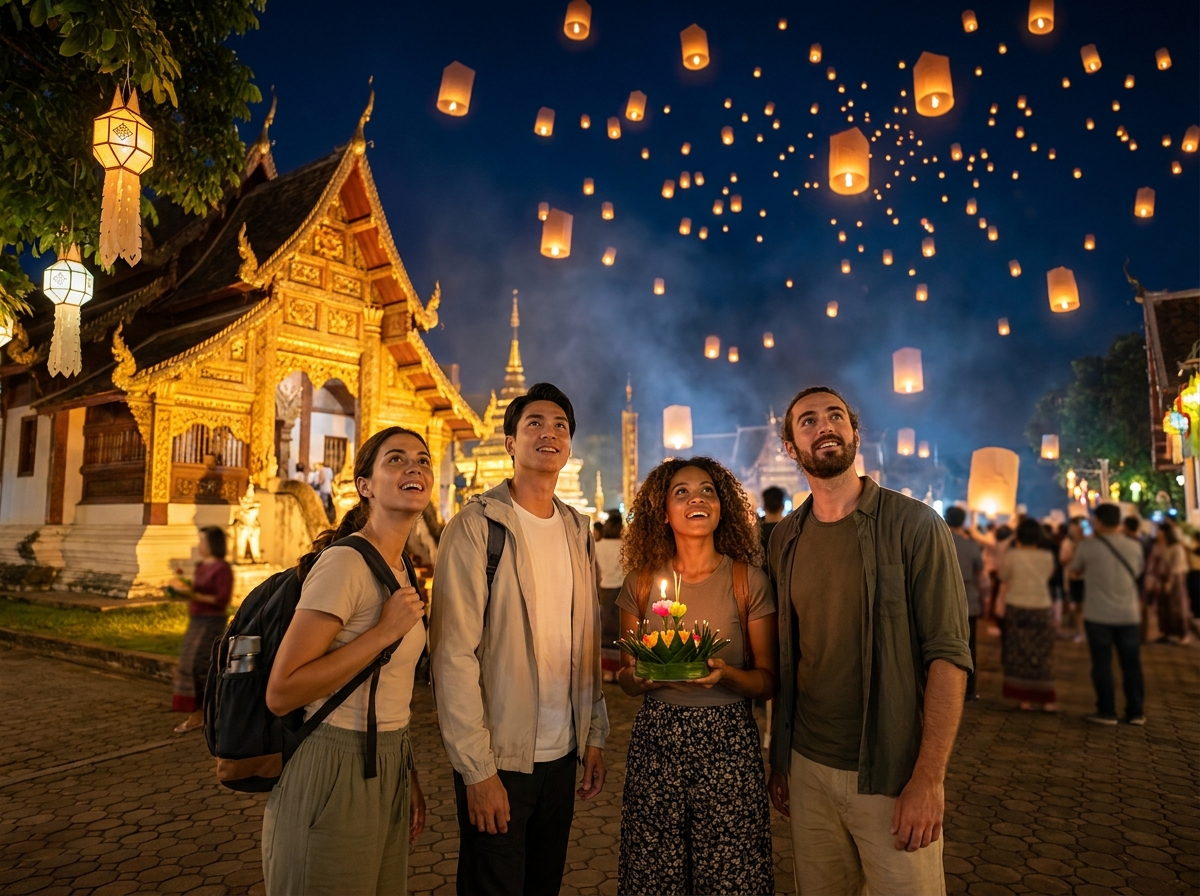
The first time I watched a Loy Krathong celebration in Chiang Mai, I expected the lights to be the main attraction.
They weren’t.
What stayed with me was the quiet moment before people released their krathongs onto the water. Families stood together, children carefully lighting candles, older people making wishes, and visitors trying to figure out which direction the river was flowing. For a few minutes, the noise of the festival seemed to disappear.
Then hundreds of little lights began drifting away.
That is what I like about Loy Krathong. It looks spectacular, but underneath the photographs is a tradition about letting go, showing gratitude and making a fresh start.
In Chiang Mai, the celebration becomes even more distinctive because it overlaps with the northern Thai Yi Peng tradition. Lanterns, illuminated temples, parades, river ceremonies and handmade krathongs turn the city into one of Thailand’s most atmospheric places to visit during festival season.
If you’re planning to experience it yourself, here’s what the festival actually means, what happens in Chiang Mai, where I would go, and how to enjoy it without getting completely overwhelmed by the crowds.
What Is Loy Krathong?
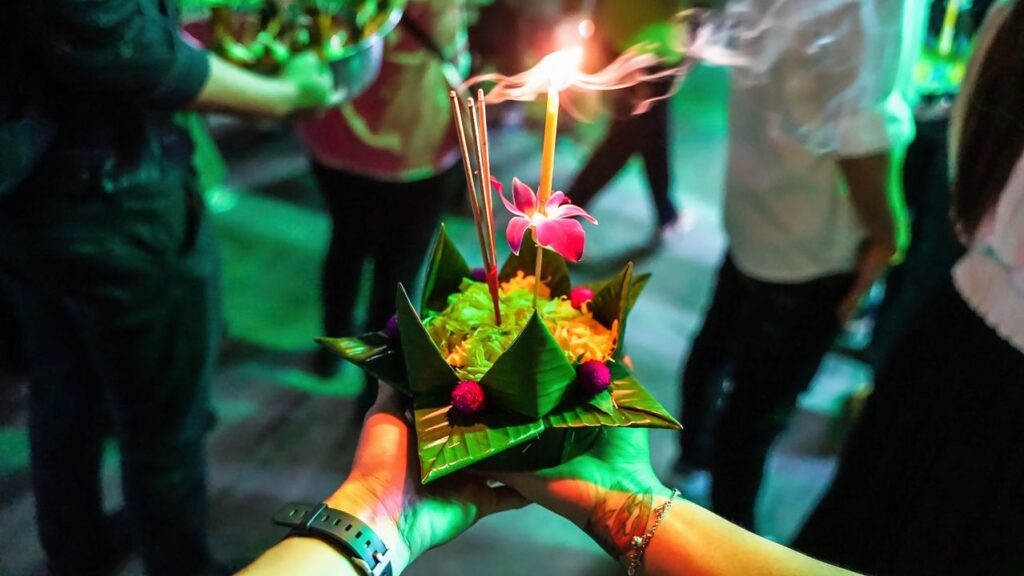
Loy Krathong is celebrated on the night of the full moon in the twelfth lunar month of the traditional Thai calendar, which normally falls in November.
The word Loy means “to float,” while Krathong refers to the small decorated floating vessel that people place on rivers, canals, ponds and other waterways.
A traditional krathong is often made from natural materials such as banana leaves and a section of banana trunk. It’s decorated with flowers, a candle and incense.
When I make one, I don’t think of it as simply putting a decoration in the river.
The act represents letting go of bad feelings, misfortune and things from the past while asking for blessings for the future.
There are also different regional customs and interpretations, so there isn’t one single explanation that covers every community in Thailand.
The important thing is that water is central to the ritual.
People give thanks to the water and ask forgiveness for using or polluting it.
That makes the festival much more meaningful than the pretty photographs suggest.
Why Chiang Mai Is Different
Chiang Mai adds another layer to the celebration through Yi Peng, the traditional Lanna festival associated with lanterns.
This is where things can get confusing for first-time visitors.
People often use “Loy Krathong” and “Yi Peng” interchangeably when talking about Chiang Mai’s famous November celebrations, but they’re not exactly the same tradition.
Loy Krathong: floating krathongs on water.
Yi Peng: associated with the Lanna tradition of illuminated lanterns, including khom loi sky lanterns.
In Chiang Mai, the celebrations often overlap, which is why you can see floating candles on the Ping River while lanterns decorate streets and temples.
That combination is what makes Chiang Mai particularly famous during this period.
When Is Loy Krathong in Chiang Mai?
The exact date changes each year because it follows the lunar calendar.
For example, the Chiang Mai Yi Peng/Loy Krathong celebrations in 2025 were scheduled across November 4–6, according to the Tourism Authority of Thailand’s event update. Activities included a large krathong competition, Lanna lantern displays, a river ceremony, traditional performances and floating krathongs.
For a future trip, I wouldn’t rely on a generic “Loy Krathong is in November” calendar.
Check the official Chiang Mai municipality and Tourism Authority of Thailand announcements closer to your travel dates because the dates, venues and individual activities can change.
The important thing to remember
You don’t necessarily need to attend an expensive private lantern event to experience the festival.
Some of the most memorable moments happen around ordinary public celebrations.
Where I Would Celebrate in Chiang Mai
1. The Ping River
If I could choose only one location for Loy Krathong, I’d go to the Ping River.
This is where the meaning of the festival becomes obvious.
Instead of simply watching decorations, you’re surrounded by people actually participating in the tradition.
Find a suitable public area along the river, buy a locally made krathong, light the candle and incense, make your wish and carefully place it on the water.
The river can get extremely busy, though.
I’d arrive before sunset rather than turning up at 8 PM expecting an empty riverside.
You won’t get one.
2. Tha Phae Gate
Tha Phae Gate is one of the main gathering areas in Chiang Mai and is a particularly good place to experience the public atmosphere.
The historic gate sits on the eastern side of the old city and is already one of Chiang Mai’s most popular landmarks. Tourism Thailand describes it as an important historic gateway into the old city.
During festival periods, the area becomes dramatically busier.
Expect:
- Festival decorations
- Traditional performances
- Food stalls
- Cultural activities
- Large crowds
- Parade activity
- Lantern displays
The atmosphere is fun, but this isn’t where I’d go if I wanted peace and quiet.
It’s where I’d go if I wanted to feel the energy of Chiang Mai during the festival.
3. The Old City Temples
One of my favorite ways to experience the festival is to spend some time around Chiang Mai’s temples before heading toward the river.
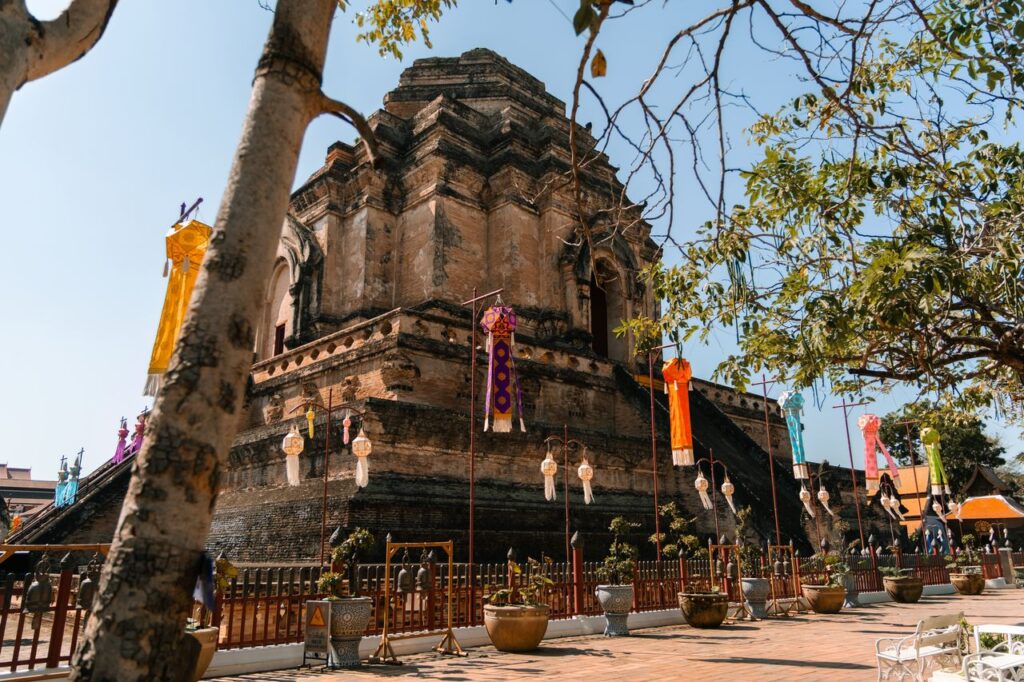
Wat Phan Tao, Wat Chedi Luang and Wat Phra Singh are all within the old city area and are among the city’s best-known cultural sites. Tourism Thailand highlights these temples alongside Tha Phae Gate as key attractions around the historic center.
During festival season, temples may be decorated with lanterns and traditional Lanna elements.
The atmosphere changes as daylight disappears.
Instead of rushing between attractions, I like to walk slowly through the old city, stop for food and see how local residents prepare for the evening.
My preferred route
Wat Phra Singh → Wat Chedi Luang → Wat Phan Tao → Tha Phae Gate → Ping River
It’s walkable, although your feet may complain by the end.
4. Warorot Market and the Riverside Area
If you want something more local-feeling before the main celebrations, I’d wander around Warorot Market and the surrounding riverside streets.
This area is excellent for food.
Instead of arriving at the festival starving and immediately paying tourist-area prices for everything, eat something beforehand.
I usually look for:
- Sai ua northern sausage
- Khao soi
- Grilled meat
- Sticky rice
- Fresh fruit
- Thai desserts
Then head toward the river after sunset.
That way, you’re free to explore rather than standing in a food queue while everyone else is trying to find somewhere to eat.
5. A Traditional Temple Ceremony
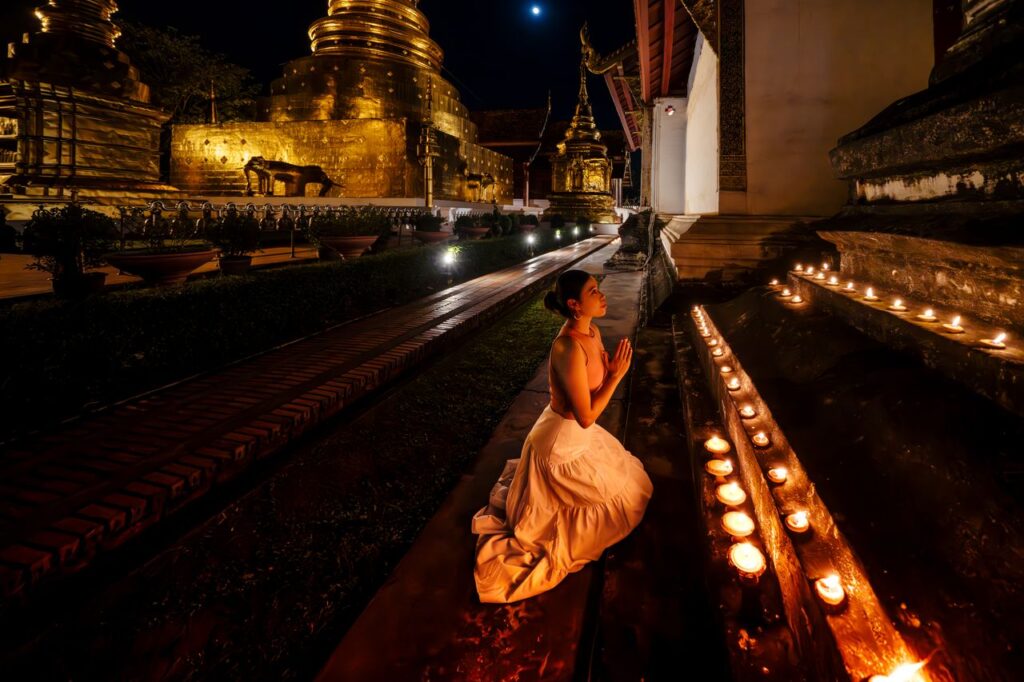
If you’re interested in the meaning of Loy Krathong rather than just the photographs, spend some time at a temple.
Festival activities can include merit-making, prayers, traditional ceremonies and offerings.
This is where I think visitors can easily make a mistake.
A temple isn’t simply another photo location.
If people are praying or participating in a ceremony, I keep my distance, lower my voice and avoid walking directly in front of them for a photograph.
You can still take pictures.
Just don’t turn someone’s religious ceremony into your personal photo shoot.
What About the Famous Sky Lantern Releases?
This is probably the most photographed part of Chiang Mai’s festival season.
The image is unforgettable:
Hundreds of glowing lanterns rising into the night sky.
But there is an important distinction between officially organized lantern-release events and simply releasing a sky lantern wherever you want.
Don’t assume that because you can buy a lantern from a street vendor, you can legally release it anywhere.
Authorities impose restrictions on sky-lantern releases because of aviation, fire and public-safety concerns.
Rules and designated release zones can change from year to year.
For that reason, I strongly recommend attending an authorized event if releasing a sky lantern is something you specifically want to experience.
And if you don’t want to release one, you aren’t missing the festival.
Honestly, watching the lanterns from a distance can be just as beautiful.
Should You Book a Yi Peng Lantern Event?
It depends on what you want.
Private events can offer:
- Organized seating
- Cultural performances
- Food
- Transportation
- Coordinated lantern releases
- A more controlled viewing experience
But they can also be expensive and crowded.
If your priority is the iconic mass-release photograph, booking an established event can make sense.
If your priority is experiencing Chiang Mai’s traditional atmosphere, I’d rather spend the evening exploring public areas, temples and the river.
Don’t book an expensive package simply because you think it’s the only way to see lanterns.
What Does It Cost?
One reason I enjoy public Loy Krathong celebrations is that you don’t necessarily need to spend much money.
Your basic evening could look like this:
| Item | Typical budget |
|---|---|
| Small krathong | ฿20–฿100+ |
| Street-food meal | ฿50–฿150 |
| Drink | ฿20–฿60 |
| Local transport | Depends on distance |
| Public festival areas | Usually free |
| Private Yi Peng event | Varies significantly |
Krathong prices vary depending on size, materials and design.
I prefer a small biodegradable krathong rather than an enormous decorative one.
It floats just as well.
Choose an Eco-Friendly Krathong
This is one part of the festival I think visitors should pay attention to.
Thailand has been encouraging environmentally friendly krathongs, particularly those made from natural materials.
When buying one, ask what it’s made from.
I’d avoid plastic-heavy decorations and anything with materials that clearly shouldn’t be going into a river.
And don’t add your own plastic, coins wrapped in plastic, food packaging or other rubbish.
The entire point is to honor the water.
Leaving trash behind would rather defeat the purpose.
What to Wear
November evenings in Chiang Mai can be pleasantly cool, particularly compared with Bangkok.
But festival crowds can still make you warm.
I’d wear:
- Lightweight trousers or longer shorts
- Breathable shirt
- Comfortable walking shoes
- Light jacket
- Small crossbody bag
If you’re visiting temples, dress respectfully.
Cover your shoulders and knees where required.
And wear shoes you can walk in for several hours.
Festival night isn’t the time to discover that your fashionable sandals are actually medieval torture devices.
How to Get Around
This is where planning ahead helps.
During the festival, major roads around Tha Phae Gate, the old city and riverfront can become heavily congested.
I wouldn’t rely on a private car.
Walking is often easier within the old city.
For longer distances, use:
- Grab
- Songthaew
- Tuk-tuk
- Taxi
- Hotel-arranged transport
But expect delays.
If you’re meeting friends somewhere, give yourself extra time.
And don’t schedule a restaurant reservation on the opposite side of Chiang Mai immediately after a festival parade.
The traffic may have other plans.
My Ideal Loy Krathong Evening
If I were visiting Chiang Mai specifically for the festival, this is how I’d plan the day.
Afternoon
Start around the old city.
Visit a temple or two.
Stop for coffee.
Eat an early dinner.
Around 5:00 PM
Walk toward Tha Phae Gate.
Look at the decorations and festival activities.
Don’t rush.
Around sunset
Start moving toward the Ping River.
Buy a small krathong from an appropriate vendor.
Early evening
Find a suitable public riverside area.
Watch families and local residents release their krathongs.
Then release yours.
Later
Walk through the festival areas and enjoy the food stalls.
If there is an official lantern event you’re attending, follow its transport and release instructions.
Otherwise, I’d simply enjoy the public celebrations.
Around 9:00–10:00 PM
Start heading back before the biggest crowds begin leaving simultaneously.
That’s one of my favorite travel tricks:
Leave a little before everyone else.
What I Wouldn’t Do
There are a few mistakes I would avoid.
Don’t release a sky lantern wherever you want
Follow current local restrictions and use authorized events.
Don’t float a plastic krathong
Choose biodegradable materials.
Don’t push through crowds for photographs
Someone’s family ceremony is more important than your Instagram shot.
Don’t carry your passport loosely
Festival crowds are exactly when I keep valuables secured.
Don’t drive after drinking
Use a ride-hailing service or arrange transportation.
Don’t assume every lantern release is legal
Rules can change.
Don’t expect an empty riverbank
Chiang Mai during Loy Krathong is busy.
Very busy.
The Meaning Behind the Candle
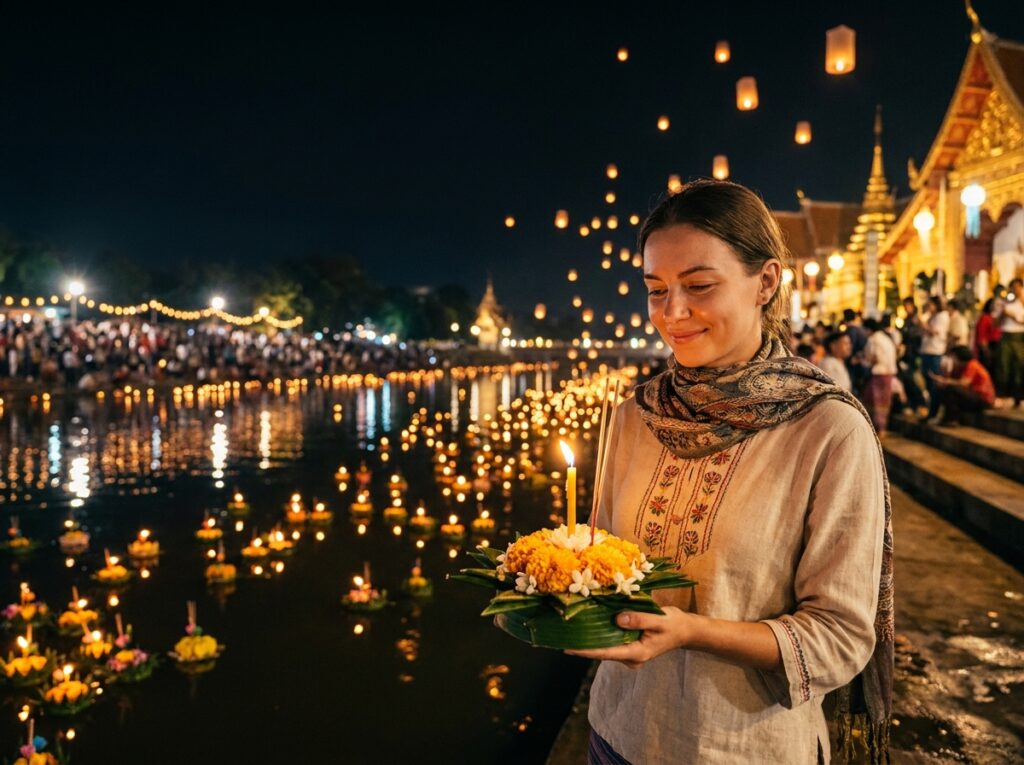
The candle on a krathong is one of the details I find most beautiful.
People light it before placing the krathong on the water.
There isn’t one universal interpretation of every element, but the ritual is closely associated with making wishes, asking for forgiveness and letting go of negativity.
For me, the most interesting part is that the ceremony doesn’t require an elaborate explanation.
You light the candle.
You make your wish.
You put the krathong on the water.
And then you watch it disappear into the darkness.
It’s a very simple gesture.
But after spending a few minutes in the middle of a noisy festival, that small moment can feel surprisingly personal.
The Best Time to Visit Chiang Mai for Loy Krathong
If the festival itself is your main reason for visiting, arrive at least one or two days before the main celebrations.
That gives you time to:
- Recover from your flight
- Explore the old city
- Find the festival locations
- Check the latest schedule
- Buy appropriate clothing
- Understand transportation
- Avoid trying to do everything on one evening
I’d stay for at least three nights if possible.
That way, you can experience the festival without turning every day into a race.
A Few Things People Get Wrong About Loy Krathong
It isn’t only a lantern festival.
The floating krathong is the central symbol of Loy Krathong.
Yi Peng isn’t simply another English name for Loy Krathong.
They’re distinct traditions that overlap in Chiang Mai.
You don’t need an expensive ticket to experience Loy Krathong.
Public celebrations can be fascinating.
You don’t need to release a sky lantern.
Watching is perfectly fine.
The festival isn’t just for tourists.
Local families, communities and temples are central to the celebration.
That’s the part I try hardest to remember when I’m there.
Why I’d Come Back
The first time you see hundreds of lights floating down the Ping River, it’s easy to focus on the spectacle.
The second time, I think you notice the people.
A grandmother helping a child light a candle.
A couple quietly making a wish.
A group of friends laughing while trying not to drop their krathong.
A monk walking through the crowd.
A vendor selling flowers beside the river.
That’s what makes Loy Krathong memorable.
The lights are beautiful, but they’re only the visible part of the celebration.
Underneath them is a simple idea that I think travels surprisingly well: let go of what you don’t need, appreciate what sustains you, and start again with a little more hope.
If you’re planning to experience Loy Krathong in Chiang Mai, don’t spend the entire evening chasing the perfect photograph.
Make your own small krathong.
Stand beside the river.
Light the candle.
Make your wish.
And watch it float away.