
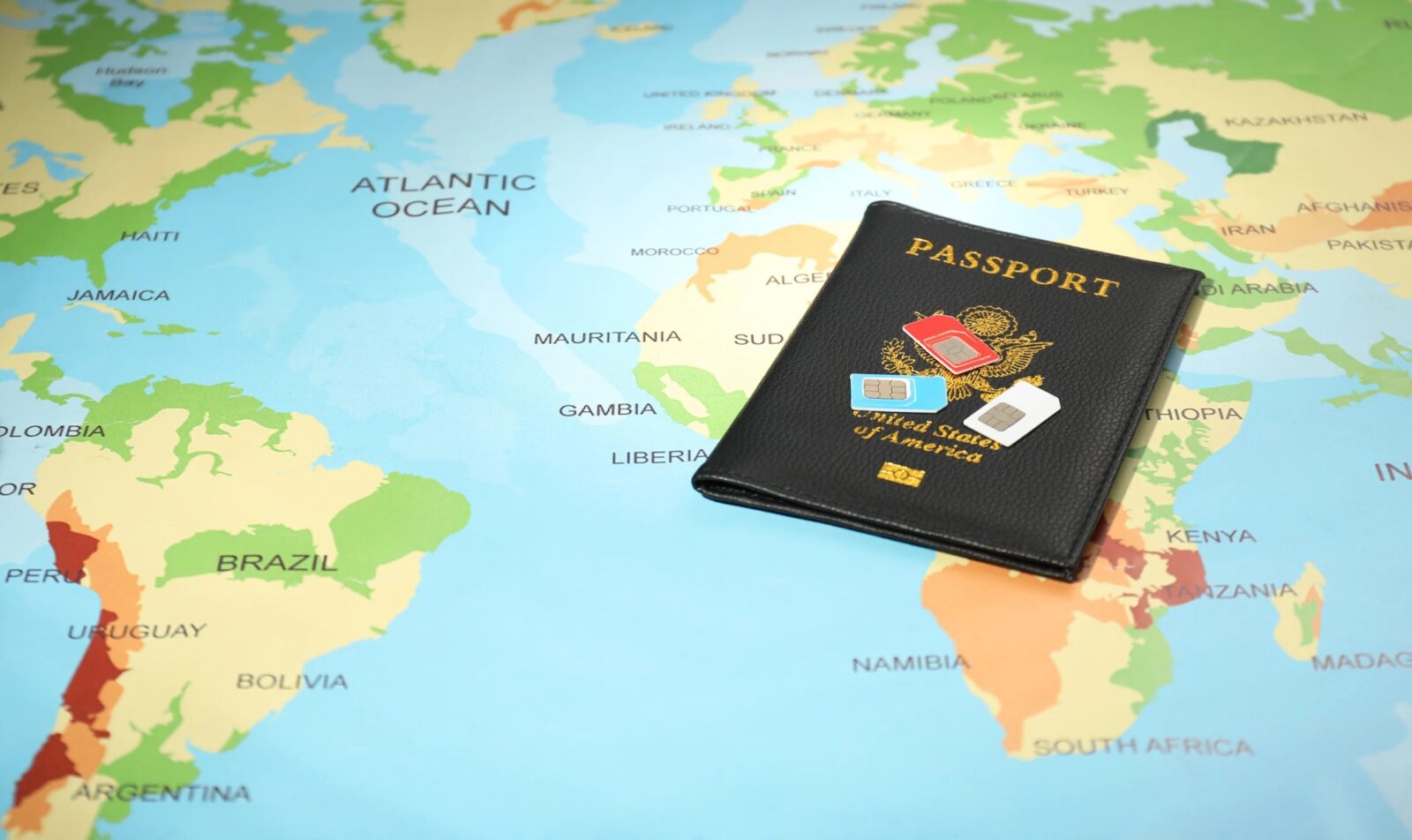
The first thing I do after landing in Thailand isn’t finding a taxi.
It’s getting mobile data.
I learned that lesson after once trying to navigate Bangkok with airport Wi-Fi, a screenshot of my hotel address, and the misplaced confidence that I could somehow remember every street name. Ten minutes later, I was standing outside the wrong exit with a suitcase, sweating through my shirt and watching three identical-looking taxis drive past.
These days, I want my phone working before I leave the airport.
For most travelers in 2026, Thailand is an easy country to stay connected. The major local networks offer 4G and 5G tourist SIMs and eSIMs, while international eSIM companies let you install a plan before your flight.
The question isn’t really whether you’ll get internet. It’s which SIM gives you the best combination of price, speed, coverage and convenience for the places you’re actually visiting.
After comparing the current tourist plans, here’s how I’d choose.
Thailand Tourist SIMs at a Glance
| Provider | Example tourist plan | Price | Validity | Data |
|---|---|---|---|---|
| AIS | Lucky Tourist SIM | ฿399 | 5 days | Unlimited 5G/4G |
| AIS | Lucky Tourist SIM | ฿499 | 8 days | Unlimited 5G/4G |
| AIS | Lucky Tourist SIM | ฿699 | 15 days | Unlimited 5G/4G |
| AIS | Lucky Tourist SIM | ฿1,199 | 30 days | Unlimited 5G/4G |
| True | Tourist Infinite SIM | ฿349 | 10 days | Unlimited 5G |
| True | Tourist Infinite SIM | ฿499 | 8 days | Unlimited 5G |
| True | Tourist Infinite SIM | ฿699 | 15 days | Unlimited 5G |
| dtac | Happy Tourist eSIM | ฿299 | 8 days | 15 GB max-speed |
| dtac | Happy Tourist eSIM | ฿599 | 15 days | 30 GB max-speed |
Prices include VAT where the operator’s current listing specifies it. Tourist offers change periodically, so I would check the operator’s page immediately before purchasing. AIS currently lists its 5-, 8-, 15-, 30- and 60-day Lucky Tourist options, while True and dtac publish their own tourist ranges.
My short version?
AIS is my pick for maximum coverage. True is excellent if you want unlimited high-speed data. dtac is interesting if you don’t need unlimited data and want to spend less.
AIS Tourist SIM and eSIM
If I’m traveling beyond the major tourist centers, AIS is usually my first choice.
AIS currently advertises its Lucky Tourist SIM/eSIM as offering 4G/5G coverage across Thailand, and its current tourist lineup includes unlimited max-speed plans.
The current prices are:
- 5 days — ฿399
- 8 days — ฿499
- 15 days — ฿699
- 30 days — ฿1,199
- 60 days — ฿1,599
These plans include unlimited 5G/4G data at maximum available speed, plus various calling and AIS Super WiFi benefits.
The 8-day plan is the interesting one
If you’re taking a normal one-week Thailand holiday, the ฿499 8-day plan is extremely straightforward.
You don’t have to calculate whether 10 GB is enough for Google Maps, Instagram, YouTube, Grab, WhatsApp, hotel searches and random browsing.
Just use your phone.
I’ve spent entire travel days using Google Maps, uploading photos, checking restaurant reviews and watching videos while waiting for trains. Unlimited data removes one little thing from my mental checklist.
Where can you buy AIS?
AIS has tourist counters at major airports, including:
- Suvarnabhumi
- Don Mueang
- Phuket
- Chiang Mai
- Chiang Rai
- Samui
- Hat Yai
AIS also sells through its nationwide shops and Telewiz stores.
If you arrive at Suvarnabhumi and want a physical SIM immediately, this is one of the easiest options.
AIS also offers eSIM purchasing, which means you can potentially have the connection ready without physically replacing your SIM card.
True Tourist SIM and eSIM
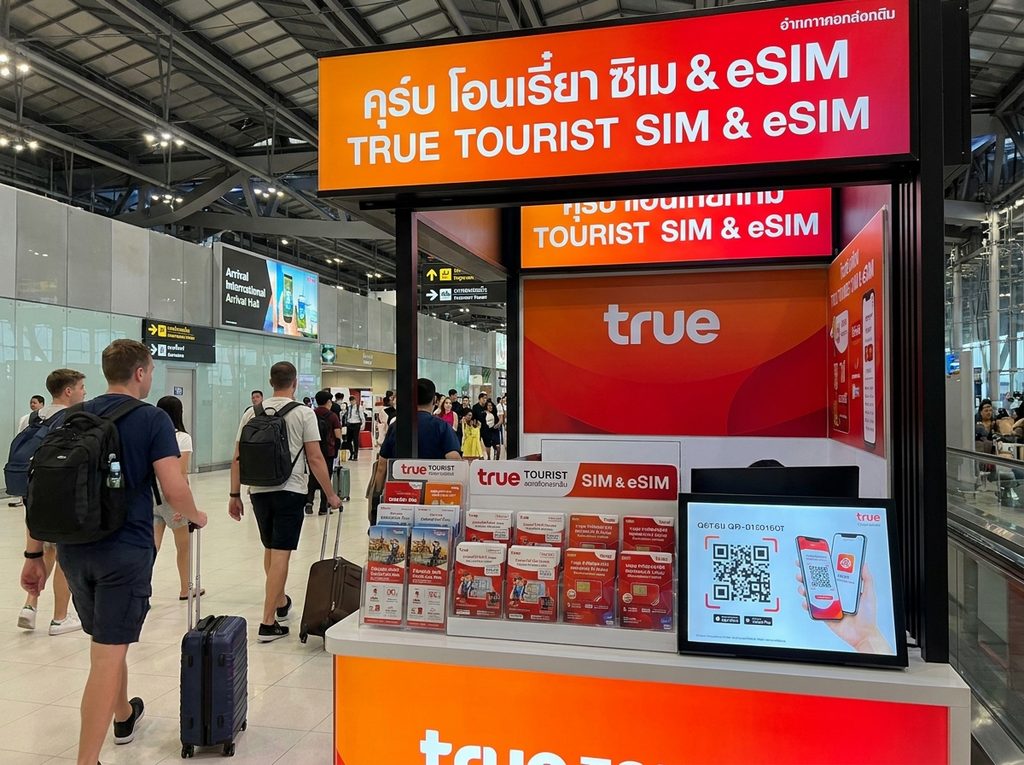
True is the other network I’d be perfectly comfortable using for a Thailand trip.
Its current Thailand Tourist Infinite SIM lineup includes:
- 8 days — ฿499
- 15 days — ฿699
- 30 days — ฿1,199
These include unlimited 5G internet at maximum available speed, unlimited Wi-Fi and local calling benefits.
There is also a 10-day tourist option for ฿349, which is particularly interesting if you’re staying for about a week and a half.
That’s actually one of the plans I’d look at closely.
Why I like True
True has a large 5G network and continues to expand coverage in tourist destinations. In August 2026, for example, True announced additional 5G network readiness on Koh Phangan to support travelers and digital nomads.
For a conventional itinerary—Bangkok → Phuket → Chiang Mai → Bangkok—I wouldn’t hesitate to use True.
The difference between AIS and True in major tourist destinations is unlikely to be dramatic enough to determine your entire holiday.
Where I’d lean toward AIS is when my itinerary includes more rural areas, mountain roads or remote parts of northern Thailand.
dtac Tourist SIM and eSIM
dtac is particularly interesting if you’re a moderate data user.
The current Happy Tourist eSIM options include:
- ฿299 — 8 days
- ฿599 — 15 days
The ฿299 plan provides 15 GB at maximum speed, followed by unlimited internet under the plan’s terms, while the ฿599 plan provides 30 GB at maximum speed for 15 days. dtac also includes calling and selected chat-app benefits.
There are also dtac Happy Tourist Infinite options:
- 8 days — ฿449
- 15 days — ฿699
- 30 days — ฿1,199
These offer unlimited 5G internet at maximum available speed and calling benefits.
When would I choose dtac?
If I know I won’t be streaming constantly, ฿299 for eight days is tempting.
For someone who mainly needs:
- Google Maps
- Grab
- LINE
- Booking apps
- Occasional video
15 GB is a lot of data.
I wouldn’t automatically pay for unlimited data just because the word “unlimited” sounds better.
AIS vs True vs dtac: Which Has the Best Coverage?
This is where I’d be careful with blanket statements.
All three can work very well in the places most tourists visit. Bangkok, Chiang Mai, Phuket, Pattaya, Krabi, Koh Samui and other major destinations generally have strong mobile infrastructure.
But if coverage is your number-one priority, AIS currently has the strongest independent performance evidence.
Ookla’s 1H 2026 Thailand network results reported AIS ahead of True/dtac on several measures, including 5G connectivity score, 5G speed score, overall network score and coverage score.
AIS reported a coverage score of 763 versus 731 for True/dtac in the Ookla results shown on its 2026 network page.
That doesn’t mean True/dtac won’t work where AIS does.
Mobile performance can change dramatically from one neighborhood to the next, especially indoors, on islands and in mountainous terrain.
But if I’m renting a car and heading into northern Thailand, I’d choose AIS.
What About International eSIMs?
This is where things become much more convenient.
An international eSIM allows you to purchase your Thailand data plan before you even leave home.
You install the eSIM while connected to Wi-Fi, configure it as your mobile-data line, and activate it when you arrive.
That means you can land at Bangkok airport, turn off airplane mode and immediately use:
Grab → Google Maps → hotel directions.
No queue.
No SIM tray.
No tiny plastic card disappearing somewhere inside your passport wallet.
The trade-off is that international eSIMs can sometimes cost more than buying directly from a Thai carrier.
And many travel eSIMs are data-only, meaning you won’t necessarily receive a normal Thai phone number.
That’s perfectly fine for many travelers because LINE, WhatsApp, Messenger and other apps handle communication.
But if you need a Thai number for local calls, deliveries or services that require SMS verification, I’d choose a local Thai tourist SIM/eSIM instead.
Should You Buy an eSIM or Physical SIM?
For me, this decision is easy.
Choose an eSIM if:
- Your phone supports eSIM
- Your phone is unlocked
- You want internet immediately after landing
- You want to keep your home SIM active
- You don’t want to visit a telecom counter
- You’re traveling between multiple countries
Choose a physical SIM if:
- Your phone doesn’t support eSIM
- You want a Thai phone number
- You want staff to install and configure everything
- You prefer a traditional SIM
- You’re staying for a long time and want a local prepaid setup
My phone supports dual SIM, so I normally keep my home SIM active for important SMS while using the Thai eSIM for mobile data.
Just make sure data roaming is disabled on your home SIM unless you intentionally want to use your home carrier’s roaming service.
That’s an expensive mistake I’ve seen travelers make more than once.
Airport SIM vs Buying in the City
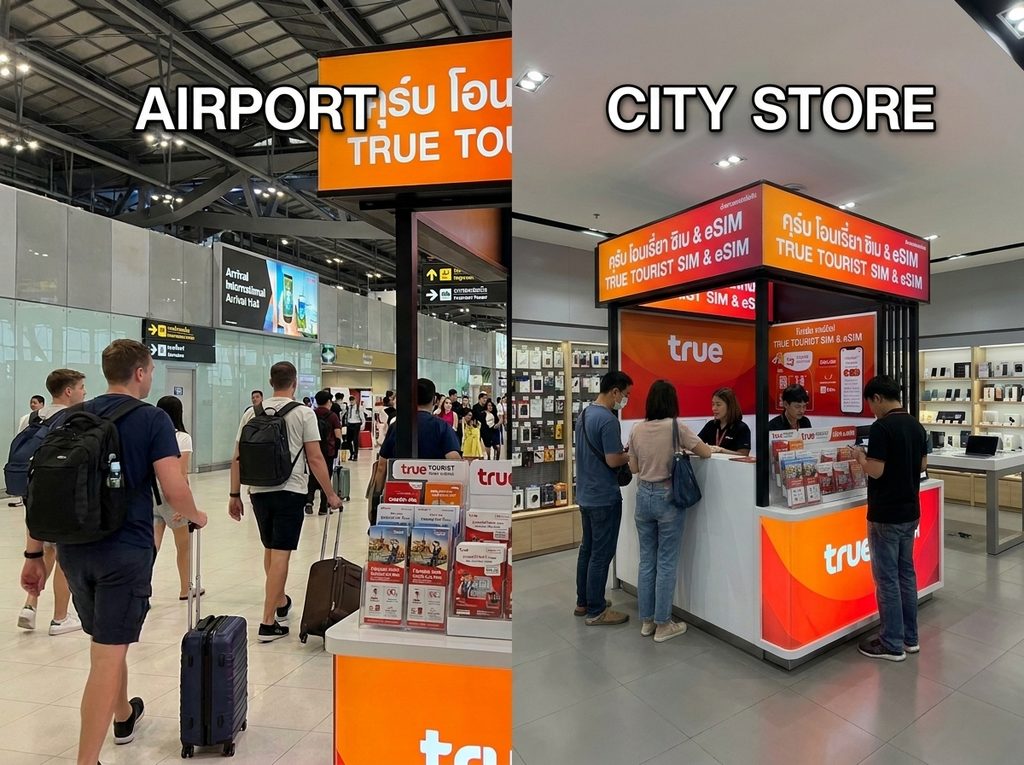
Airport SIM counters are convenient.
But convenience sometimes comes with fewer choices.
If you’re arriving exhausted after a long flight, I don’t think saving ฿100 is worth wandering around Bangkok looking for a telecom shop.
Buy the SIM.
Get online.
Get your Grab.
Get to the hotel.
On the other hand, if you’re staying in Thailand for several weeks, comparing plans at an official AIS, True or dtac store can make more sense.
Avoid buying an unknown SIM from a random street vendor just because someone offers it for a suspiciously cheap price.
Use an official carrier store, airport counter or the operator’s official online store.
How Much Data Do You Actually Need?
This is where travelers tend to overestimate their requirements.
Light user: 5–10 GB
Enough for:
- Maps
- Messaging
- Grab
- Social media
- Hotel searches
Normal traveler: 10–20 GB
This is where I’d put most people.
You’ll have plenty of data for navigation, social media, photos and regular browsing.
Heavy user: 30 GB+
Choose this if you’re:
- Uploading lots of videos
- Using your phone as a hotspot
- Streaming regularly
- Working remotely
- Making frequent video calls
Unlimited
Worth considering if you simply don’t want to think about data consumption.
For a week-long holiday, I wouldn’t necessarily pay extra for unlimited unless the price difference is small.
What I’d Choose for Different Trips
| Traveler | My pick |
|---|---|
| 3–5 day Bangkok trip | AIS 5-day ฿399 or a smaller international eSIM |
| 7-day Thailand holiday | AIS 8-day ฿499 |
| 8–10 days | True 10-day ฿349 |
| 15-day trip | AIS or True ฿699 |
| Heavy data user | AIS/True unlimited |
| Backpacking around Thailand | AIS |
| Bangkok + Phuket only | AIS, True or dtac |
| Remote northern Thailand | AIS |
| Multi-country Southeast Asia trip | Regional international eSIM |
| Phone doesn’t support eSIM | Physical tourist SIM |
For me, AIS 8-day for ฿499 is the safest all-round recommendation for a normal one-week trip.
True’s 10-day ฿349 offer is the value option I’d seriously consider.
And dtac’s ฿299 8-day eSIM is appealing if 15 GB at maximum speed is enough for your usage.
A Few Things to Check Before Buying
There are a handful of boring details that can save you a headache later.
Make sure your phone is unlocked
A carrier-locked phone may refuse to work with another SIM or eSIM.
Check eSIM compatibility
Most recent flagship and mid-range phones support eSIM, but not every model does.
Regional versions can also differ.
Bring your passport
Thai tourist SIMs must be registered with identification under Thailand’s telecom regulations. True/dtac specifically state that tourist SIMs require a valid passport for registration.
Check the activation rules
Don’t assume buying the eSIM starts the validity period immediately.
Read the activation instructions carefully.
Save your QR code
If you’re buying an eSIM before departure, keep the QR code and installation information somewhere accessible offline.
You don’t want to be sitting at Bangkok airport trying to open an email while the airport Wi-Fi decides to stop cooperating.
One Useful AIS Bonus for Travelers
AIS currently has a tourist-SIM promotion that can provide Grab discounts of up to 40% on eligible services, including airport rides, subject to the promotion’s conditions and daily limits.
If you’re already planning to use Grab heavily, that’s a nice extra.
AIS also currently advertises a 10% Rajadamnern Stadium ticket discount for Lucky Tourist SIM/eSIM customers under its 2026–2027 promotion.
These aren’t reasons I’d choose a network by themselves, but they’re useful little extras once you’re already using the plan.
My Thailand SIM Strategy
If I’m landing in Thailand tomorrow, here’s exactly what I’d do.
For a one-week holiday:
I’d buy the AIS Lucky Tourist 8-day eSIM for ฿499 before or immediately after arrival.
For 10 days:
I’d seriously consider the True Tourist Infinite 10-day plan for ฿349.
For 15 days:
I’d compare the AIS and True ฿699 unlimited options.
For a month:
I’d look at the ฿1,199 AIS or True plans and compare the current promotions before paying.
For a backpacking trip into rural northern Thailand:
I’d lean toward AIS because current independent network measurements give it the stronger coverage position.
For a Southeast Asia trip covering Thailand, Vietnam, Singapore and Malaysia:
I’d consider a regional eSIM instead of buying four separate local SIMs.
The Small Thing That Makes a Big Difference
Don’t wait until you’re standing outside Bangkok airport with no data to make this decision.
Spend five minutes before your flight checking:
- Is my phone unlocked?
- Does it support eSIM?
- How many days am I staying?
- Do I need a Thai phone number?
- Will I use lots of video?
- Am I traveling beyond the major cities?
- Do I need hotspot/tethering?
Once you answer those questions, the choice becomes pretty simple.
For most visitors, AIS is my overall pick for coverage, True is a strong alternative for unlimited data and value, and dtac makes sense for travelers who want a lower-cost plan without needing unlimited high-speed data.
And personally, I’d rather spend ฿300–฿700 on reliable mobile data than spend an afternoon lost somewhere in Bangkok trying to find my hotel.
Thailand is much more fun when Google Maps knows where you are.