
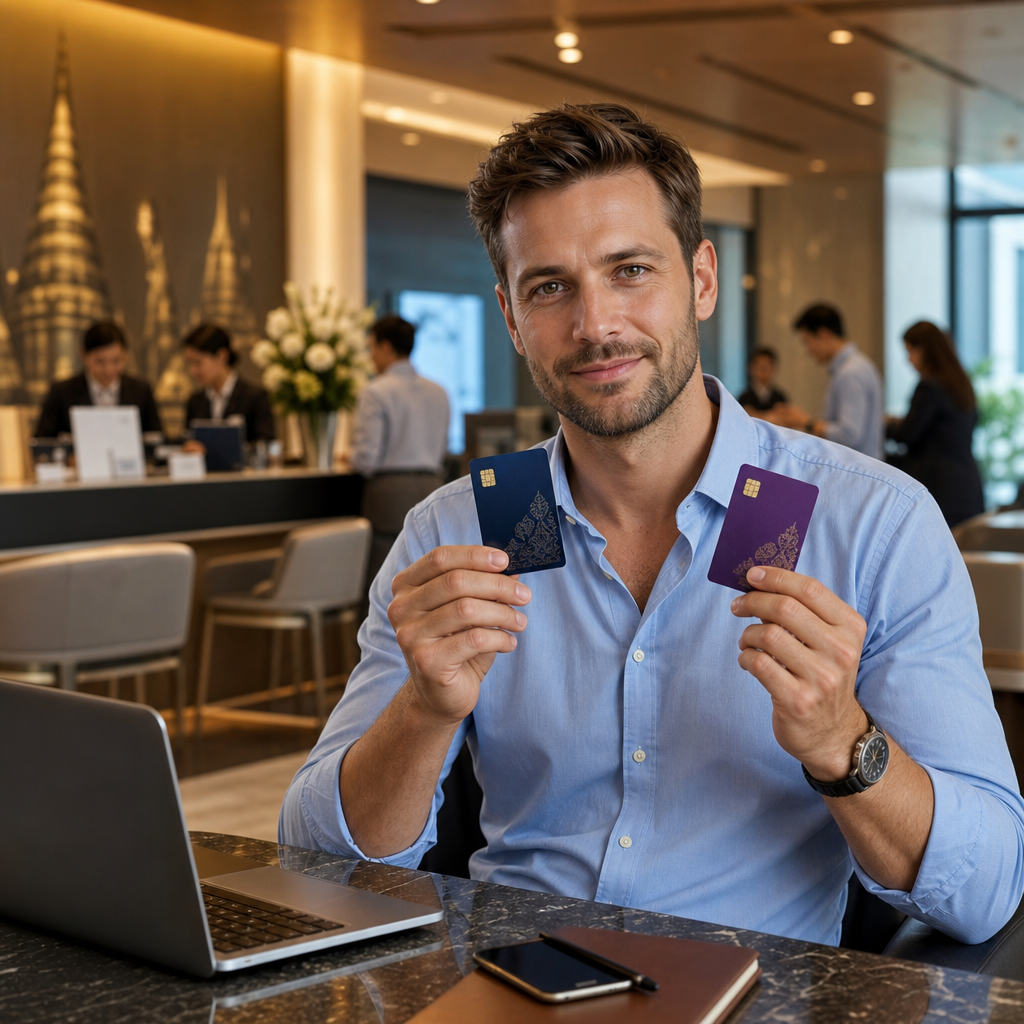
When I first moved into the world of Thai banking, I assumed one bank account would be enough. That seemed logical, simple, and efficient. After all, in the United States, many people get by with one primary checking account, maybe a savings account, and a credit card or two. But once I started living, working, and handling cross-border finances in Thailand, I realized that banking abroad is not always a one-size-fits-all decision.

Opening two different Thai bank accounts instead of one turned out to be one of the smartest financial decisions I made. It gave me more flexibility, better access to services, less stress during account issues, and a much cleaner way to manage both personal and business money. For Americans considering expat life, international investing, remote work, retirement abroad, or business setup in Southeast Asia, this is a lesson worth understanding.
This article explains why I chose two Thai bank accounts, how each account serves a different purpose, what I learned about Thai banking as a foreigner, and why this setup can be especially valuable in 2026 when digital banking, cybersecurity, and global finance are more important than ever.
The Short Answer: I Needed Separation, Flexibility, and Backup
The simplest reason I opened two accounts was that one account could not do everything I needed.
One account became my everyday spending account. The other became my backup and operational account. That separation made it easier to manage bills, income, transfers, ATM withdrawals, and savings goals. It also reduced risk. If one bank had a technical problem, card issue, or verification delay, I still had access to funds through the other.
For Americans used to the convenience of mobile apps, Zelle-style transfers, high-yield savings products, and integrated online banking, Thai banking can feel different. It often requires a little more planning, especially when you are dealing with visa requirements, international wire transfers, banking compliance, or local payment systems like PromptPay.
The result was not just convenience. It was better financial control.
Why One Thai Bank Account Wasn’t Enough
At first, I believed a single Thai bank account would cover everything. I wanted to receive funds, pay rent, withdraw cash, and maybe make a few local transfers. But reality quickly showed that different banks in Thailand often excel in different areas.
One bank might be better for ATM access, while another has a more reliable mobile banking experience. One may be friendlier to foreigners with specific visa types, while another may be easier to use for everyday living expenses. One might work better for business payments or international transfers, while another may offer more convenient branch support.
If you are coming from the U.S. financial system, where products are often bundled and standardized, this can feel surprising. But in Thailand, having multiple bank relationships can be a practical strategy rather than an unnecessary complication.
I also wanted to protect myself from the kind of inconvenience that can happen with any financial institution: card blockage, app verification issues, account review, branch paperwork, or temporary limits. In banking, redundancy is not wasteful. It is risk management.
How I Decided to Split My Banking Needs
Before opening both accounts, I thought through my actual financial life. That made the decision easier. I asked myself what I needed my bank to do, and I realized I had at least two distinct categories.
One was for daily life: rent, food, transport, bill pay, and ATM withdrawals. The other was for money I wanted to preserve, move, or manage separately, including income from freelance work, business deposits, international transfers, and emergency reserves.
This approach is similar to how smart business owners structure their finances in the United States. A company may use separate accounts for payroll, operating expenses, taxes, and reserves. The same logic applies in personal finance, especially when you are in a foreign country where money movement can be slower or more regulated than you expect.
A Simple Breakdown of My Banking Strategy
| Account Type | Main Purpose | Why It Helped |
|---|---|---|
| Primary Thai Bank Account | Daily spending, bills, ATM use, local transfers | Easy access for everyday life |
| Secondary Thai Bank Account | Backup, savings, business-related use, transfers | Reduced risk and improved organization |
This structure gave me clarity. I no longer mixed all my money into one place and hoped for the best.
Convenience Was Only Part of the Story
A lot of people think the reason to open two bank accounts is just convenience. That was part of it, but not the whole story.
The deeper reason was that I wanted a better financial system for my life in Thailand. A good financial system should help you do at least three things well: spend efficiently, save securely, and move money without unnecessary friction.
With only one account, I had less flexibility. I had to make sure I kept enough balance in case of app issues or bank delays, which meant leaving extra money sitting idle. I also had no clean way to isolate funds for a future trip, emergency expense, or investment opportunity.
With two accounts, I could build a more organized structure. I could leave a working balance in one account and keep a safer reserve in the other. That may sound basic, but in finance, basic systems often create the strongest results.
One Account for Spending, One for Stability
This was the biggest practical advantage.
My primary account became the one I used for everyday spending. It held enough for routine life, subscriptions, groceries, transportation, and local purchases. I didn’t worry if I used the card often because I knew the balance was meant for active use.
My second account had a different job. It acted more like a buffer. I used it for extra cash storage, less frequent transfers, and as a fallback if the first account was not working. It gave me psychological comfort, but it also improved actual financial resilience.
For Americans who are used to emergency funds, money market accounts, business reserves, and diversified portfolios, this idea should feel familiar. It is the same principle applied in an international setting.
Thai Banking Can Be Friendly, But It Can Also Be Specific
One thing I learned quickly is that Thai banks can be very useful, but they are also particular about process. Depending on the bank, branch, visa status, and account type, you may need different documents. Some branches are more foreigner-friendly than others. Some applications move quickly, and some are more document-heavy.
That is why having two accounts at different banks can be helpful. It reduces dependence on one institution’s policies. If one bank is slow to issue a new debit card, if mobile banking needs a reset, or if an international transfer is delayed, the second bank can keep your life moving.
For an American reader, think about how annoying it would be if your only U.S. bank account was temporarily inaccessible while a bill was due. Now imagine that same issue while living abroad. The stakes are higher.
Better Support for International Transfers and Cross-Border Finance
If you are an American living in Thailand, traveling regularly, or earning income from the U.S., international transfers matter. Maybe you receive freelance payments, retirement income, rental income, consulting fees, dividends, or business revenue. Maybe you move money from a U.S. bank, brokerage account, or digital payment platform into Thailand.
Two accounts gave me better control over this flow.
One account handled local use. The other was better for receiving larger or less frequent transfers. This helped me avoid confusion between money I needed for living and money I wanted to keep separate for taxes, savings, or planned purchases.
Cross-border finance can also intersect with legal and tax considerations. Americans still need to understand reporting obligations, foreign account compliance, and the broader implications of holding overseas funds. In 2026, this is especially important as global banking compliance, anti-money-laundering systems, and digital verification standards continue to evolve. Having a clean separation between accounts makes recordkeeping far easier.
Why It Helped With Budgeting and Cash Flow
Budgeting in a foreign country becomes much easier when money is separated by purpose. I found that opening two bank accounts gave me a natural system for cash flow management.
Instead of looking at one large balance and trying to remember what was already spoken for, I could see what money was available for daily life and what money was reserved. That made me more disciplined.
It also helped me avoid overspending. When all your cash sits in one account, it is easy to mentally blur the lines between spending money and savings. Two accounts created a simple wall between the two.
Budget Flow Example
Income
  ↓
Primary Account → Rent, food, transport, bills
  ↓
Secondary Account → Emergency reserve, transfers, business buffer, savings
This kind of structure is basic, but powerful. It is one of the same reasons financial advisors in the U.S. recommend separate accounts for different goals.
Banking Redundancy Is a Form of Financial Risk Management
A second Thai account is not just a convenience tool. It is a risk management strategy.
In finance, one of the most important rules is never to rely on a single point of failure. That idea applies in banking, investing, business operations, cloud computing infrastructure, cybersecurity, and insurance planning. Whether you are managing a startup, a digital agency, or your personal household finances, redundancy matters.
If a card gets swallowed, a mobile app stops working, or a bank asks for a document update, your life should not come to a standstill. With two accounts, I had a built-in backup. That reduced stress significantly.
This mattered even more because I often had obligations that could not wait, such as paying rent, moving money for travel, or making business-related payments. A backup account may not feel exciting, but in practice, it can be the difference between smooth operations and unnecessary disruption.
It Helped Me Compare Banks in Real Life
Another unexpected benefit of having two Thai bank accounts was that it allowed me to compare banks based on actual usage, not marketing promises.
I could see which app was easier to use, which customer service team was more responsive, which branch was more efficient, and which bank handled transfers better. Real experience is much more useful than general assumptions.
This comparison mattered because banking decisions affect more than day-to-day convenience. They affect your long-term financial health. The easier your bank makes it to save, transfer, and manage money, the more likely you are to stay organized.
In a world where people compare credit cards, mortgage rates, investment platforms, business checking accounts, and insurance policies, comparing banks is simply smart consumer behavior.
Table: Why Two Thai Bank Accounts Beat One
| Factor | One Account | Two Accounts |
|---|---|---|
| Spending control | Harder to separate cash flow | Easier to manage by purpose |
| Backup access | No fallback if problems occur | More resilience if one account is unavailable |
| Budgeting | Can feel messy | Cleaner financial structure |
| International transfers | All funds mixed together | Easier to track incoming and outgoing money |
| Foreigner convenience | Limited if bank policy changes | More flexibility across institutions |
| Stress level | Higher | Lower |
How This Approach Fits American Financial Habits
Many Americans already use multiple accounts without thinking of it as unusual. A checking account for spending, a savings account for reserves, maybe a business account for freelance work, and a credit union account for backup are all common. That mindset translates well to Thailand.
The difference is that in Thailand, the benefits are amplified. Because banking rules, app systems, branch support, and foreign customer policies may vary, having more than one relationship can make life easier.
If you have experience with retirement planning, small business ownership, real estate investing, or financial software in the U.S., the idea of separating money into functional buckets will already make sense. Thai banking just gives you another reason to put that strategy into practice.
Digital Banking in 2026 Makes Multiple Accounts Even More Useful
In 2026, banking is more digital than ever. Mobile apps, QR payments, instant transfers, remote verification, AI-driven fraud detection, and cloud-based banking systems are everywhere. That is great for convenience, but it also means outages, verification loops, and account security issues can happen more than people expect.
This is one reason I’m glad I had two Thai bank accounts. When digital banking works perfectly, life is easy. When it doesn’t, having a second account can keep you moving.
Cybersecurity is another reason. If one account is linked to a card or payment app that gets compromised, a second separate account can reduce immediate exposure. No bank account is immune to scams, phishing, or unauthorized access attempts. Smart account separation is a simple layer of protection.
For Americans paying attention to identity protection, data privacy, and online banking fraud, this is not a trivial issue. It is part of modern financial defense.
Business Owners and Remote Workers May Benefit Even More
If you are not just a resident or retiree, but a freelancer, consultant, agency owner, or remote worker, the case for two Thai accounts becomes even stronger.
One account can serve personal life. The other can support business operations, project income, vendor payments, or tax planning. That separation makes bookkeeping cleaner and reduces confusion during tax season or when working with a CPA, tax attorney, or financial advisor.
This is especially valuable if your work involves digital marketing, AI consulting, cloud services, software subscriptions, or international client payments. When income and expenses are clearly separated, it is easier to track profitability, estimate quarterly obligations, and maintain accurate records.
Business owners in the United States already understand the value of separate accounts for liability and accounting purposes. The same logic applies when operating internationally.
The Emotional Side: It Made Me Feel More in Control
Finance is not only about numbers. It is also about stress, confidence, and peace of mind.
Opening two Thai bank accounts made me feel more in control of my environment. I was no longer one technical issue away from inconvenience. I had options. That simple feeling had real value.
Money management is often less about maximizing every single feature and more about reducing friction in daily life. When you are in a foreign country, friction can turn into real stress very quickly. Two accounts lowered that stress.
What I Would Tell an American Considering the Same Move
If you are a U.S. citizen or American expat thinking about opening a Thai bank account, consider whether one account is really enough for your life. If you plan to live in Thailand long term, earn income there, send money internationally, or manage both personal and business finances, two accounts may be a much better fit.
You do not need to open multiple accounts just for the sake of it. But if each account has a purpose, the benefits can be substantial. One account for spending and one for reserve or business use is a practical, mature financial setup.
It is similar to choosing the right health insurance plan, comparing mortgage options, evaluating business software, or reviewing legal services before signing a contract. The point is not complexity for its own sake. The point is building a structure that supports your life.
Final Comparison: The Real Value of Two Thai Bank Accounts
| Benefit | Practical Result |
|---|---|
| Separation of funds | Easier budgeting and reduced confusion |
| Backup banking access | Less risk if one account has issues |
| Better recordkeeping | Cleaner finances for tax and business use |
| More flexibility | Easier transfers, withdrawals, and payments |
| Lower stress | More confidence in daily money management |
| Improved risk management | Stronger financial resilience |
Conclusion: Two Accounts Was the Right Call
I opened two different Thai bank accounts instead of one because I wanted more than basic banking. I wanted a system that could support daily life, protect me from disruption, help me manage cross-border money, and keep my finances organized as an American abroad.
In hindsight, it was not an overcomplication. It was a smart financial structure.
If you are used to the financial tools and conveniences of the United States, it may be tempting to assume one account will do everything in Thailand. But once you account for local banking differences, international transfers, digital security, and the need for backup access, two accounts starts to look less like a luxury and more like a practical necessity.
In 2026, with banking technology advancing, cybersecurity threats increasing, and global finance becoming more interconnected, the value of separation, redundancy, and clarity is only growing. For me, opening two Thai bank accounts was not just about banking. It was about creating a better financial life.